How breeding works
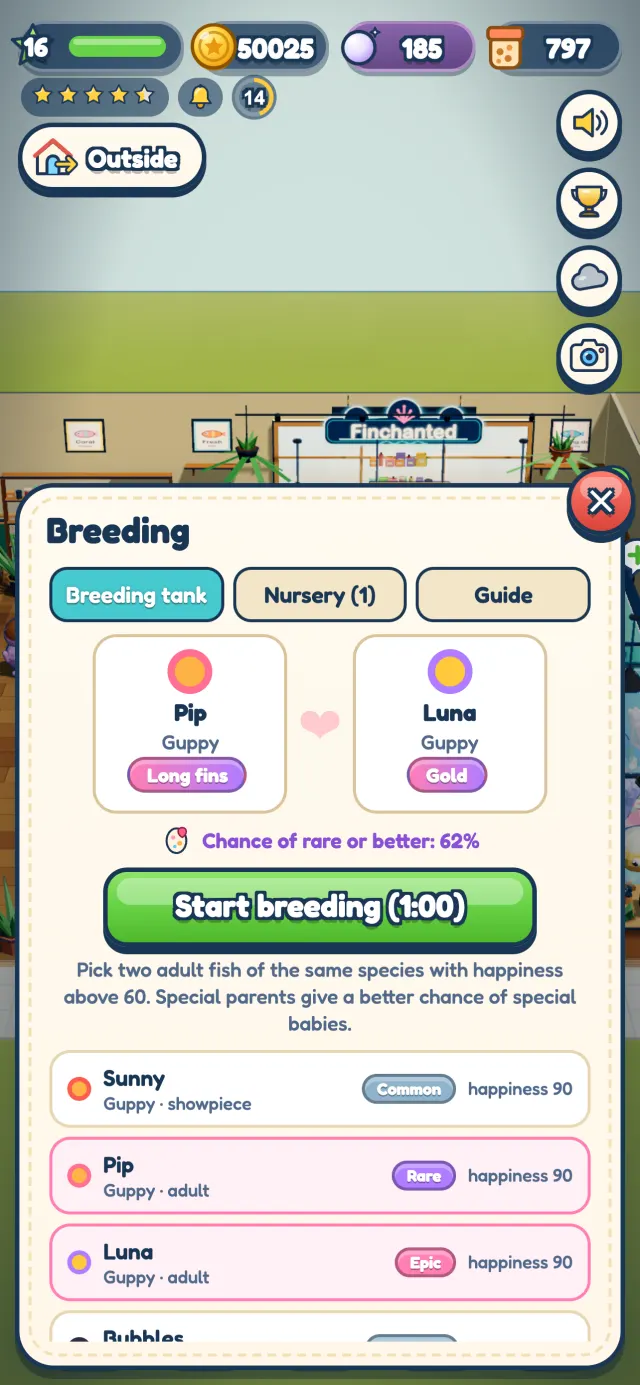
Your breeding tank opens at level 3. Pick two different fish of the same species, both adult or showpiece, who are happy and doing well. After a timer, eggs appear in the breeding tank. You collect them and they move to the nursery, where they hatch as soon as a suitable tank has room.
Real genes
- Body and accent color come from either parent, and sometimes blend into a new shade.
- Pattern: plain, stripes, spots or bands. Once in a while a special pattern mutates in: koi patches, network, halfmoon or eyespot.
- Fins: round fins, fan tail or tall fins. There are rare shapes here too: veil tail, lyre tail, delta tail and double tail.
- A parent's trait does not always pass on, so every clutch is a surprise.
Rare traits
Albino, black and long fins are rare. Gold, glow and crystal are epic. Rainbow is legendary and only comes from two parents with an epic trait. The pairing screen shows your chance of rare or better.
Hidden genes
Some fish carry a recessive gene you cannot see: true albino, leucistic or sun gold. It only shows when a youngster gets the gene from both parents. So two carriers together give you a shot at a surprise.
Look inside the genes
At level 5 you can research the microscope. The fish card then shows pattern, fins, trait and whether a fish is a carrier, with the chance a youngster inherits it. From level 8 the gene scan also reveals exact colors and mutation chances.
Crosses and the full moon
A few related species can breed together: platy and guppy, goldfish and bitterling, koi and golden orfe. Each egg then has a 5% chance of a cross, like the gupplaty. Crosses are rare and cannot be bred any further. And on the night of the real full moon, the chance of a mutation is one and a half times as high.
Pure lines
When a fish shares its pattern with three generations of ancestors, it is a pure line. It is worth 25% more and gives extra XP when it hatches. Bought and caught fish have no family tree, so a line starts with your own breeding.